
Is Your Makeup Toxic?
Originally posted in July 2013. Updated in May 2026.
Could your makeup be impacting your health? If you've wondered if your makeup is toxic, you are not alone.
For most of us, we've been reaching for our foundation in the morning or swiping on a coat of lipstick for years without a second thought. It's something many of us use every single day, layered directly onto our skin. As you move through your natural living journey, you might start to question what's actually in those products.
I used to think conventional makeup couldn't be all that bad, since so many people used it without seeming to keel over. I was wrong.
As a Nutritional Therapy Practitioner, I look at what goes on your skin through the same lens as what goes in your body, because over time, the two aren't as separate as we might think.
This post isn't meant to scare you; I'm very much a “progress over perfection” kind of person, and I know that overhauling your entire makeup bag overnight is neither realistic nor necessary. But I do think it's worth understanding what you're putting on your skin every day, so you can make informed choices that feel right for you. That's the No Fuss Natural way.
The Short Answer: Yes, Conventional Makeup Often Contains Questionable Ingredients
Here in the United States, the last major federal law regulating personal care product ingredients was passed in 1938. That's not a typo. While the European Union has banned or restricted more than 1,300 ingredients in cosmetics over the past two decades, the US has banned only around 11.
The result? A market full of products that may contain ingredients that other countries have deemed unacceptable.
A 2004 study by the Environmental Working Group found that 89% of the roughly 10,500 ingredients used in personal care products had not been evaluated for safety by the FDA, the Cosmetic Ingredient Review panel, or any other publicly accountable institution. Even the FDA has stated that a cosmetic manufacturer may use almost any raw material as a cosmetic ingredient and market the product without FDA approval.
That's a significant gap.
The “oversight” of the cosmetics industry falls largely to the Cosmetic Ingredient Review (CIR) panel — a group funded by the cosmetics industry itself. And when the CIR does review ingredients, it's primarily looking at immediate reactions like rashes and allergies, not chronic, low-dose exposures, which is exactly how we're using these products every single day.
Why Makeup in Particular?
Our skin is the body's largest organ, and what we apply to it is absorbed into the body to varying degrees. This is especially true of products that:
- Stay on the skin all day (rather than being rinsed off)
- Cover a large surface area (like foundation or body lotion)
- Are applied near mucous membranes (like lipstick)
One study by the EWG found that women use an average of 12 personal care products containing 168 unique chemical ingredients every single day. When you consider that exposure compounds over time — day after day, year after year — it's worth paying attention.
Ingredients to Be Aware Of
You don't need to memorize a chemistry textbook to make better choices. Here are some of the most common ingredients in conventional cosmetics worth knowing about.
Parabens
Parabens are widely used preservatives — and they appear in an estimated 75–90% of personal care products. They include methylparaben, ethylparaben, propylparaben, butylparaben, and isobutylparaben, and you'll usually see them listed by name on ingredient labels.
Research has raised questions about parabens' potential to mimic estrogen in the body, which has prompted attention from researchers studying hormonal health. In 2014, the European Commission took a harder stance and banned five types of parabens, with stricter limits on others.
What to look for: Any word ending in -paraben on an ingredient list.
Phthalates (Hiding in “Fragrance”)
Phthalates are a class of chemicals used to help fragrance last longer in personal care products. Here's the tricky part: they won't appear on the label by name. Instead, they hide under the word “fragrance” or “parfum.”
Fragrance formulas are legally protected as trade secrets, which means manufacturers don't have to disclose what's actually in them. A single fragrance ingredient can be a blend of hundreds of individual chemicals — including ones linked to hormone disruption and skin sensitization.
The best way to minimize phthalate exposure is to choose products that are fragrance-free or that specify natural fragrance made from essential oils.
What to look for: Avoid products listing “fragrance” or “parfum” unless the brand specifies it's naturally derived.
Sulfates (SLS and SLES)
Sodium Lauryl Sulfate (SLS) and Sodium Laureth Sulfate (SLES) are foaming and cleansing agents commonly found in shampoos and cleansers. They can strip the skin's protective barrier and are known skin irritants for many people.
SLES has an additional concern: during manufacturing, a byproduct called 1,4-dioxane can be formed. Multiple agencies — including the EPA and the National Institutes of Health — consider 1,4-dioxane a likely or reasonably anticipated carcinogen.
What to look for: SLS, SLES, sodium lauryl sulfate, sodium laureth sulfate. Also watch for ingredients ending in -eth (like ceteareth, myreth, oleth).
Formaldehyde Releasors
Formaldehyde itself isn't typically added directly to cosmetics, but certain preservatives called formaldehyde releasors can release small amounts of formaldehyde over time. Formaldehyde is classified as a known human carcinogen.
What to look for: DMDM hydantoin, imidazolidinyl urea, diazolidinyl urea, quaternium-15, and bronopol.
Lead in Lipstick
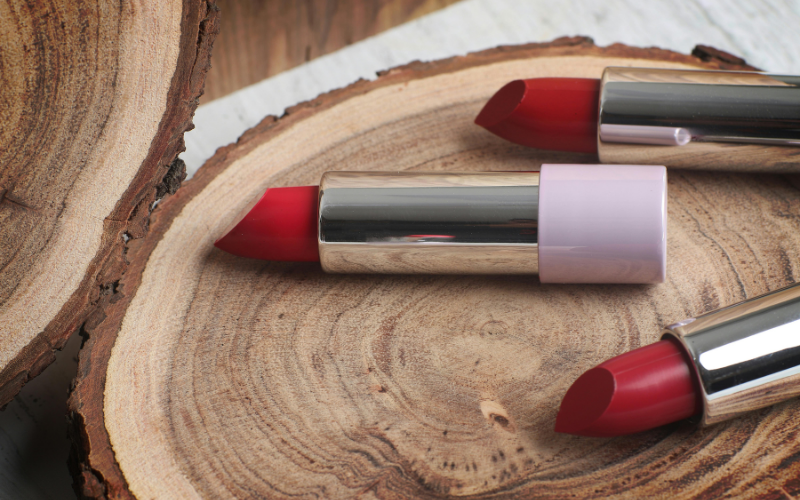
This one surprises a lot of people. Lead, a heavy metal with well-established health concerns at any level of exposure, has been found in many conventional lipsticks. Given how often lipstick is reapplied throughout the day — and the reality that some of it is ingested — this is one area where making a cleaner swap sooner rather than later makes a lot of sense.
The No Fuss Approach: Where to Start
Here's where I want to reassure you: you do not need to replace everything at once. In fact, trying to do so all at once is a fast track to overwhelm, and overwhelm is the enemy of lasting change.
Here's how to think about it practically:
Prioritize Products That Stay on Your Skin All Day
Products that cover a large area and sit on your skin for hours have more potential for absorption than something you rinse off quickly. For makeup, that means foundation and tinted moisturizer deserve your attention first.
This can be tricky when shopping online since it's hard to match shades without trying them. A few things to keep in mind:
- Check return and satisfaction policies before you order.
- Some brands offer samples you can try before committing to a full-size product.
- Start with a smaller or travel size when trying a new brand.
Swap Lipstick Sooner Rather Than Later
Because of the concerns around lead in conventional lipsticks and the frequency with which it's reapplied (and inadvertently ingested), making the switch to a cleaner option here is a worthwhile priority.
Replace One or Two Products at a Time
As one source I love puts it: if you stop using two of your ten daily products, you've reduced your exposure by 20%, multiplied across 365 days of the year, year after year.
That adds up.
Reduced exposure is still reduced exposure, even if you're not replacing everything at once.
If You're Still Using Conventional Makeup in the Meantime
A few simple habits can help minimize exposure while you're in the process of transitioning:
- Wear makeup less often when you can. Choose makeup-free days or makeup-free hours at home.
- Wash makeup off as soon as possible when you're done — don't wait until bedtime if you can help it.
- Focus on other areas of your health, too: good sleep, hydration, and nourishing food all support your body in processing what it's exposed to.
How to Check a Product
You don't have to research every ingredient yourself. A couple of free tools make it much easier:
- EWG Skin Deep Database — Search any product or ingredient and see how it's rated for safety concerns. This is my go-to starting point.
- Think Dirty App — Scan product barcodes to get a quick rating on ingredients.
These tools aren't perfect, and ratings can vary depending on the database. But they're a great first step when you're evaluating a new product.
A Quick Note on the Word “Natural”
Don't be fooled by marketing language. “Natural,” “clean,” and “green” are not regulated terms — any brand can use them. Some products marketed as natural still contain questionable ingredients, and some conventional brands have cleaner formulas than their “natural” counterparts.
This is why learning to read labels (or using the tools above) matters more than trusting packaging.
Clean Makeup Brands Worth Knowing About
Since I can no longer recommend Beautycounter (the company has closed), I want to share some of the brands I've seen getting consistently good reviews in the clean beauty space. As always, I still recommend checking individual products on EWG Skin Deep, since formulas can change without notice.
A few well-regarded options to explore:
Westman Atelier — It's definitely a splurge, but if you're looking to invest in one hero product, their foundation is exceptional (it's my current favorite). Clean formulas and luxurious performance.
100% Pure — One of the most established and widely loved clean beauty brands, with a broad range of makeup options.
ILIA Beauty — Great performance, very popular for foundations and tinted serums.
Kosas — Beloved in the clean beauty community, especially for complexion products.
Araza Beauty — Uses whole-food ingredients; lovely options for eyes and cheeks.
Au Naturale — Certified organic, great for lipstick, especially.
Juice Beauty — USDA certified organic options, good foundation range.
Jane Iredale — Long-standing mineral makeup brand with good performance.
Honest Beauty — More widely available (Target carries it), good for those just starting out.
Ogee — A Vermont-based brand with NSF-certified organic formulas, meaning at least 70% organic ingredients across their entire line, which is a genuinely high bar. Their sculpted complexion and face sticks have developed a devoted following for good reason.
Counter (formerly Beautycounter) — Recently rebranded from Beautycounter, and still making solid products. I've tried their lipstick and tinted moisturizer and liked both. I'll be honest that the brand's transition was hard to watch for many of the consultants who had built businesses around it, but if you're shopping for clean makeup, the products themselves hold up.
Shopping for Multiple Brands at Once
One of the easiest ways to explore clean makeup without hunting down individual brand websites is to shop through a retailer that has already done the vetting for you. A few worth knowing:
Credo Beauty is one of the largest clean beauty retailers in the US, with both online and physical stores. They have their own “Clean Standard” that all brands must meet, which takes some of the guesswork out of it. Great for browsing and trying new brands. They also have fantastic sales a few times a year!
The Detox Market is another well-curated option, carrying brands like RMS Beauty and others that meet their clean criteria. They also offer samples of many products, which is especially helpful when you're trying to match a foundation shade without committing to a full-size purchase.
Both are good places to start if you want to compare several brands in one place. And both frequently run sales, which makes the investment a little easier.
Sephora carries a growing selection of cleaner brands, such as ILIA. If you have a Sephora near you (including the smaller shop-in-shop locations inside Kohl's stores), it's worth browsing in person, especially for foundations where being able to swatch shades makes a real difference. Just keep your EWG app handy, since Sephora carries the full spectrum from clean to conventional and doesn't curate by ingredient standards the way Credo or The Detox Market do.
The Bottom Line
Your makeup routine is an important area to consider when it comes to reducing your overall body burden (the accumulation of toxins we're each exposed to through daily life). But it doesn't have to become a source of stress.
Start where you are. Make one swap when you run out of something. Use tools like EWG to check products you're curious about. Choose makeup-free time when it works for you.
Small changes, made consistently, really do add up. And every swap you make is a step in the right direction. No perfection required.



I use Bare Minerals makeup and love it. Is it toxic as well? Thank you for your time.
Hi Teresa,
I think Bare Minerals is just fine, but I haven’t done a lot of research on that particular brand. If you are ever wondering about any of the skin care or cosmetics you use, their ratings can usually be found in the Environmental Working Group database: http://www.ewg.org/skindeep/
Hope that helps.
I use Bare Minerals- only the products with no aluminum, like the foundation. I love the 100% Natural Lip line products, but they ceased making them!
I also love Sobe Botanicals (amazing lip products!), Larenim, Concrete Minerals. Many private companies have come and gone like Raesin Images, Earth-Glo and Earthen Glow. I always am on the hunt for good products that are natural/ toxin free. Even with the “natural” ones, read the ingredient list! I don’t want talc, aluminum, etc on my skin.
After reading this I think I will make the switch to toxin-free makeup. I never knew makeup can have so much toxin in them. I thought it was highly regulated, but I guess I was wrong. Thanks for the heads up.